


Confessions of a Serial Entrepreneur – This Will Be Our Year
This post will take you back to the Things journey. In the previous post we were in 2010 with the second best-selling game at Hasbro and we were excited. We thought this would be the year that they would pour money into our game and send it on a meteoric rise in sales. Now in 2008-2009 they cut 200 jobs in the plant at East Longmeadow, Massachusetts facility. The cuts were mostly union factory workers that made their board games. This facility was their games center of excellence and every cut affected their board game division. This was the first blow, but the second blow came when they decided to move about 150 marketing and game-development positions out of East Longmeadow to Pawtucket, Rhode Island. It takes about 1 hour and 45 minutes to drive from one city to the other, which rules out the ability for employees to commute. Many employees could not make the move due to family reasons and many key people left the company. This year was supposed to be our year but the company was undergoing major turmoil.
We were thinking maybe they would still spend on us as we were the shining stars but along with the employee cuts came cuts in advertising dollars. Many of the more established games had royalty contracts that had a guaranteed advertising expenditure, while we did not. And because advertising dollars were cut, Hasbro was forced to spend their ad dollars meeting the contracts that had those guarantees. The solution they came up with was to market us along with longstanding games they had, as a family game night. They would run an ad for Taboo and then tag on the end of the ad, other great games for family game night. We were in the mix of the other great games. Sales went from 450,000 units in 2010 to 222,000 units in 2011. The staff reduction and reduced ad spending were killing us, coupled with the fact that our contract did not have a guaranteed ad spend. In 2012 we made the decision to pull the game from Hasbro and move it to a rising game company called PlayMonster. When you pull a game from a company, they have a six-month sell-off period in the contract to liquidate the existing games on hand. In 2012 Hasbro sold 128,000 games.
Many start-ups think the product is 80% of the work, but I would argue that marketing is critical to success. Your success as a business is equally split between the two. You need to be focused on both and marketing and development/production need to be joined at the hip. Marketing provides the real-world feedback that development/production so desperately needs, to be able to figure out if what they are building fits the need. Marketing also translates what has been built into a set of product features and benefits that can be sold. In the case of the “Game of Things” we had to try to encapsulate how this game, unlike others, can have you in tears of laughter. Sounds easy, but it is one of the most difficult things to do.
I have always struggled to figure out when to hire a marketing team. If you hire too early, you are burning precious cash on wages instead of ads. If you hire too late, then you may not have the time to find the voice of the product and launch with substandard marketing. Both the product and marketing have to be hitting their groove at the same time. Hard to do when deadlines get pushed. I would err on the side of too early as a lot of trial and error has to happen before you find the right feel, look and voice of the product business.
Now we are moving on with a new company, still not really having that big push that would take us to the next level. To do this would require an incredible media campaign behind us.
When you have a sell-off year as we just did with Hasbro the new company is usually conservative in the first year as they know there are still games out there on the market and do not wish to over-order or overspend. In many ways, it is like starting over again, it’s a new dance. In 2013 we sell 95,000 games. In 2013 we start to work on new versions of our game, one of which was an adult version. In that same year we see a game on Kickstarter raising money for a game called Terrible Things, one of the names we had in mind for the adult version. We own the trademark Things… in both Canada and the US. We decided that Terrible Things is too close to our name and we decided to send the creator of the game a cease-and-desist notice basically stating that the name of his game is in violation of our trademark. He takes the letter and posts it on his Kickstarter campaign and then all hell breaks loose. We get people sending us nasty emails. A tribe of Terrible Things followers go onto Amazon, and anywhere they could leave a review and start slamming us. The mob had taken over and it was not fun. What made the narrative even worse is that we had just moved away from Hasbro but many thought it was Hasbro exercising their muscles, and not some poor one-man company. Tom finally got in front of the guy and talked with him and calmed things down. However, the damage was done and all those negative reviews were still on Amazon, etc. I think they are finally gone.
The anger was aimed at how a company can trademark the word “Things”. It turns out you can and we did in the party game space. If you have a brand name you must protect it. We had to send cease-and-desist letters on a couple more occasions but in those cases they were using our graphics, cards, etc. to rip off our game. Don’t love this industry as your game is just one variation away from a new game. In the industry “Cards Against Humanity” is called bad apples because it was a rip-off of the game Apples to Apples.
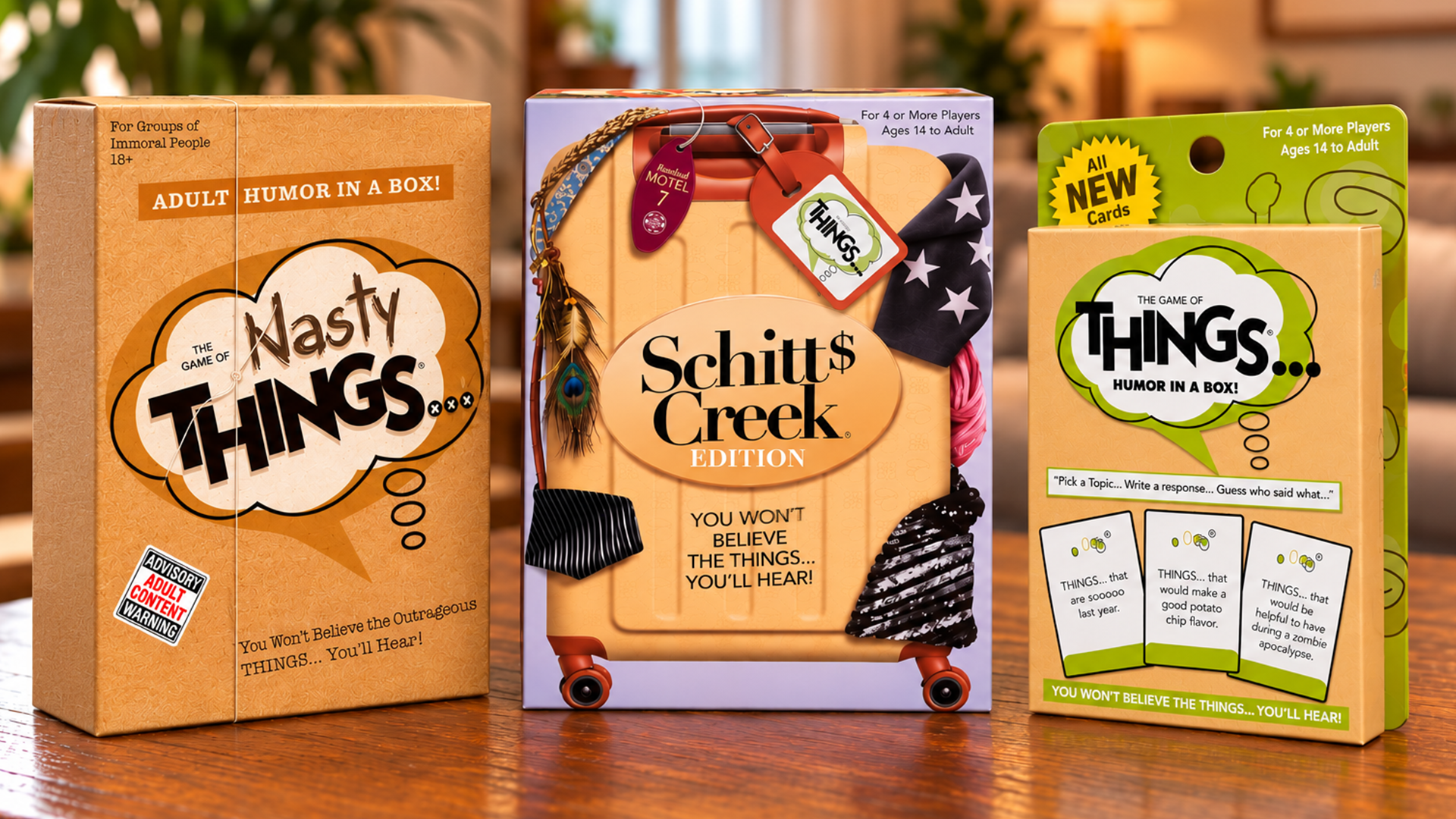
Then in 2015 PlayMonster releases two new versions of our games. They released a travel version, which is like an expansion pack. They also released an adult version of the game called Nasty Things, both of which went on to sell well, and in 2015 we sell 425,000 games. We sell approximately 500,000 games per year for the next three years and life is good. PlayMonster was also spending a good deal on advertising Things. This spending was accelerated through funding that PlayMonster received from a private holding company that had invested in them. The ads were the cute – but not “cry from laughing “ funny. We still have not seen a commercial or ad that is “cry from laughing” good.
Now in 2019 PlayMonster starts reducing the ad spend as cash is becoming scarcer, so our sales drop for the next two years, until PlayMonster decides to land a deal to do a Schitt’s Creek version of the game. This was launched in 2021 and we sold 227,000 units that year. We were helped by Covid as everyone hunkered at home and started binge-watching. Everyone wanted a break from the real world and Schitt’s Creek took off in popularity. We rode the wave.
In 2022 troubles came to a head at PlayMonster, as they had serious cash flow issues. All advertising spending was stopped on our game which would bite us in the end. We sold 239,000 games that year but we saw the writing on the wall. In 2023 we decided to look for a new partner. We signed with Mattel and now PlayMonster has a six-month sell-off period. They sold a lot of games but for a fraction of the usual price. The Mattel contract would start in 2024.
However, because PlayMonster stopped advertising, we were pulled by Walmart and Target who expect games to be supported by advertising. Looking back we should of put in our own money to advertise during this time to support the game – 20/20 hindsight.
When I hear the term “overnight success”, I think people have no idea of the work that went on behind that success. Once again we felt like we were starting over and in actuality we were. We have 40 shareholders and any excess cash earned over this period was distributed as dividends to the shareholders.
One of my favourite genres of music is Motown – I think the songs are timeless. This week’s song is “Games People Play” by the Spinners. Another song I love by the Spinners is Then Came You, featuring Dionne Warwick. Crank that song up and it is hard to not sing and dance along.