


Confessions of a Serial Entrepreneur – We Made It – Well We Think We Have
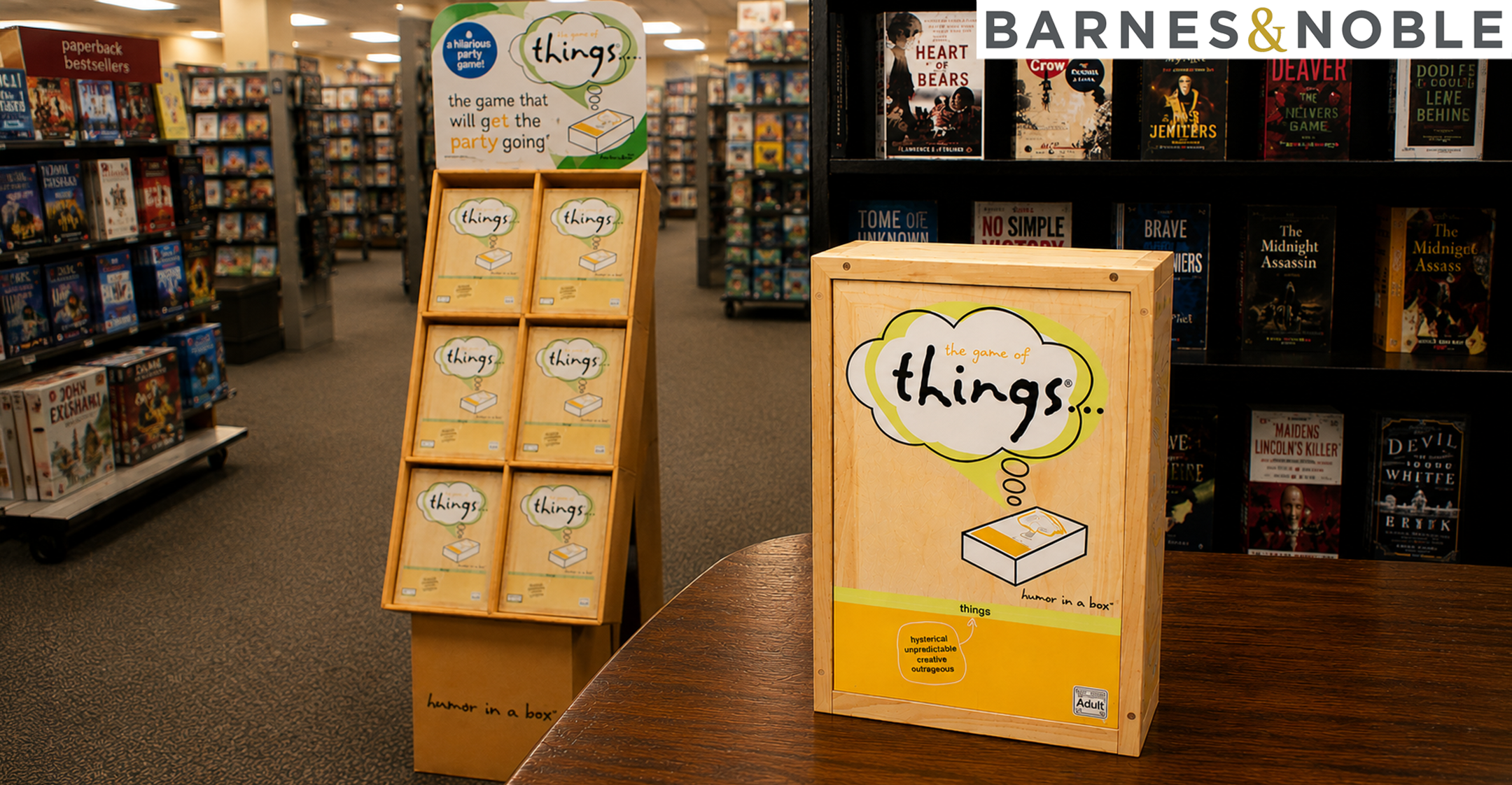
To carry on from two posts ago, we had launched “Things Humour in a Box” over Christmas and signed up to go to the Canadian Toy Fair in Toronto in February 2003 – a trade show that no longer exists. I think Tom had the idea of building a giant box as our backdrop to our booth. We certainly stood out with our unique display. We signed up about 12 retailers at the show that were willing to sell the game in their stores. Even more important was that we met the owner of Outset Media, a Canadian game distribution company, at the show. We sent him a game as soon as we returned home from the show. He played the game with his office staff on the following Friday. They loved it and wanted to distribute it for us. Normally things do not happen this fast, but sometimes the stars align. It took us until June to finalize the contract, but in July of 2003 Outset started to distribute our game across Canada and the US to independent retailers and smaller chains such as Scholar’s Choice or Mastermind. We sold over 7,000 games in our first fiscal year with them.
A distributor just distributes your game and does not manufacture them. So, we still had to find a place to get them manufactured and all roads lead to China, as nobody in North America could touch their prices. We found a company and placed an order for 10,000 games You really need a solid reference when doing work in another country for the first time and we found a reputable agent. The cost per game was $6.60 US plus shipping. At the end of August 2003, we placed our order. I think I remember this correctly but 10,000 of our games fit into one shipping container. Now the average container ship carried approximately 2,040 containers in 2003. To date we have sold over 5 million copies of the game or about ¼ of the shipping capacity of a container ship. It is hard to visualize the number 5 million. It is enough to give everyone a copy at 100 packed Blue Jays games – more than one season. By comparison the best-selling Canadian game, Trivial Pursuit, has sold 100+ million copies. Container ships carry about 4,500 to 6,000 containers today.
For the next four years we remained with the same distributor and our sales peaked at around 11,000 to 13,000 games per year. Outset at the time had not broken into the large stores, so our growth was limited because of their reach. Our agreement was up with Outset so we moved our distribution to a company called Northbridge. Northbridge had larger chains like Chapters in their mix of locations that carried the game, but they still did not have the big players, i.e. WalMart. We sold about 25,000 games with Northbridge and then in 2006 we won the Canadian Toy Testing Council Top Ten Toy Award – which was a big deal back in the day. We were the only non-multinational company to win, and also the only toy made in Canada on the list. Because of this success Hasbro came knocking.
Now when Hasbro comes knocking you think you have made it and your mind races with illusions of grandeur. Hasbro is the largest toy/game company in the world and, at the time, also owned all of the major game brands in the world. Needless to say, we were excited. We signed a royalty agreement and eagerly anticipated the future. Hasbro, being a large conservative company wanted to test our game in just Barnes & Noble in 2007. So, we were exclusive to Barnes & Noble in 2007. We were not happy about the design of the box but we sold around 35,000 games in 5 months with no advertising. That is the power of distribution. Now we thought we had proven the potential and we would launch nationwide. Nope. Hasbo wanted to do another exclusive deal, this time with Target. We sold 70,000 games in five months at Target. It was the best incubation of a game ever for Target and Hasbro. One ad in USA Today pushed sales to 10,000 games in one week. Hockey stick growth here we come.
I read something recently, something to the effect of when you get offered a chance to ride on a rocket ship don’t ask what your title, position or pay will be, just get the hell on. I agree with this statement as it is way more fun to be at a growing company than one with mature market growth rates, or one struggling to stay afloat, or worse declining revenue. On a rocket ship you are going to learn through a fire hose, and you will be given way more latitude than you would be in a more stable company. Get on, learn and grow – only good things will come from it. You will have way more opportunities to advance your career there or in the future. You are now on the fast track – it’s like jumping the queue at Disney but for your career. Not all jobs are equal and the sooner you understand that the better off you will be. When you are starting to burn out or get bored it is probably time to leave – and you will have lots of options with the experiences you’ve had.
Now in 2009 Hasbro makes the call to take “The Game of Things” into mass market across Canada and the US. Sales rose to 350,000 games. Hasbro did a small 4-week cable TV buy with two animated TV commercials. These are still the best commercials I think have ever been made for our game. Most of our commercials are cute but not funny as they need be okay for TV. Our first commercials were simple and got the point across. Here is the first commercial of “Things you shouldn’t do the first day on the job – the stick man photocopying his ass is funny – https://www.youtube.com/watch?v=OkZ9fC-PrXE. The second video was pretty good as well –https://www.youtube.com/watch?v=Jsvlu5H9hV4.
In 2010, sales rose to 450,000 games, our sales were up 12% while all other Hasbro games were down in sales. We were the 2nd best selling Hasbro game that year. I believe Taboo was #1 but I also think they were counting international sales for Taboo and we were just in North America. We thought to ourselves why are they not piling the money into Things given our success? This is still a mystery to us. Hasbro sales overall dipped a bit in late 2010, but they did not know that going into the Christmas season. We do know that with the success of Transformers launched in 2007, all attention was given to brands/properties that could expand into TV or movies. For whatever reason (still not clear to me today) when they should have poured gasoline on the fire, they did the opposite. When you license your product to a company, as long as the licensee meets the required numbers in the agreement, you pretty much take a back seat and have little say.
Still, we were having great success and thought maybe this was just a blip and next year Hasbro would come to their senses. With this shift in attention to movies, we started to wonder are we in the Right Place Wrong Time (a song by Dr. John).